
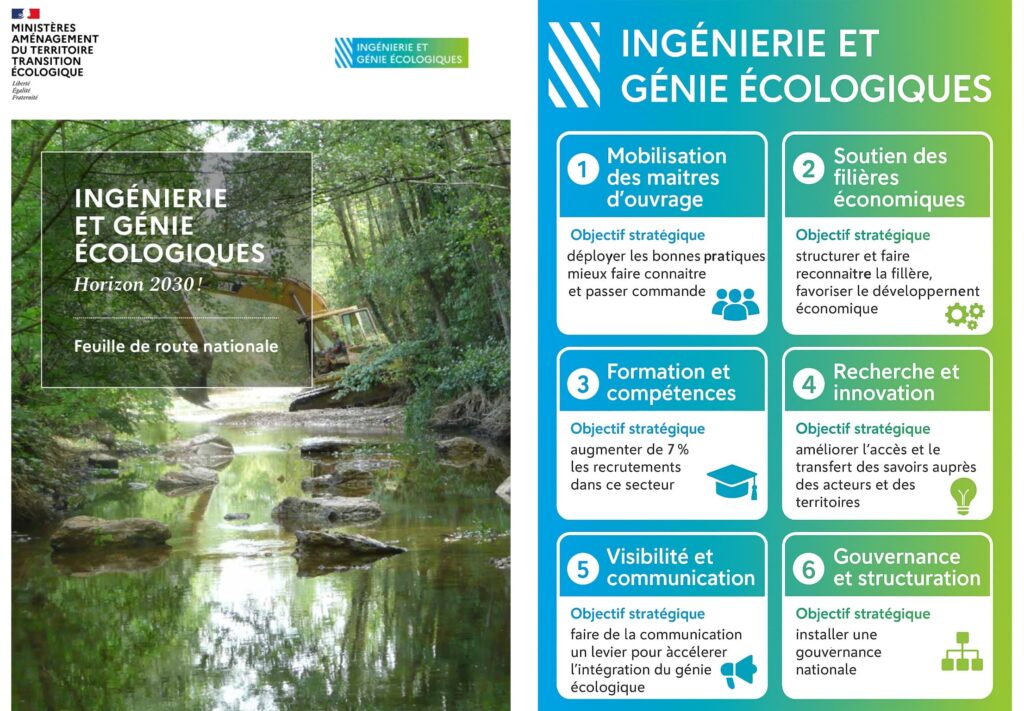
The new roadmap for ecological engineering and engineering, horizon 2030, was officially launched on June 24, 2025. More than 50 actions are planned within 6 major ambitions.
A national strategy for biodiversity
The objective of this roadmap? Making ecology operational through concrete projects led by communities, developers, manufacturers or managers of natural areas.
A dual ambition : To generalize the use of ecological engineering and engineering in all development projects. To standardize the quality of project support across the entire territory.
This roadmap is organized into 6 axes and is structured around 15 structuring actions and 40 complementary actions, all intended for project management, companies, research actors and training.
Strong and essential involvement of A-IGEco and its member networks
The A-IGEco operational team and the many volunteers from member networks worked intensively in 2024 and early 2025 to produce 25 action sheets led or co-led by our federation (out of the 55 present in the roadmap).
Actions where A-IGEco (operational team and/or member networks) is the lead or co-lead :
- Positionner l’ingénierie et le génie écologiques comme outil d’intégration de la biodiversité dans les projets des élus : de la planification aux travaux
- Creation of a “Public Procurement Support Toolkit” specifically for ecological engineering and engineering.
- National Prize for Ecological Engineering: proposing a strategic initiative for the winners
- Helping buyers find a service provider and developing sourcing (= scaling up and showcasing) through the National Directory of Engineering and Ecological Engineering Companies
- To present a case for the economic viability of ecological engineering and nature-based solutions
- Towards a structured sector: towards a strategic sector contract and the creation of a French activity classification code
- Future outlook: to implement workforce and skills planning for the sector
- Adapting insurance and guarantees to the challenges, studies and work based on living organisms and/or their users
- Integrating technical and scientific knowledge into public procurement: updating the specifications in accordance with technical and scientific advances
- Launch a study on the types of existing markets where ecological engineering could be deployed.
- Organize and develop local supply chains, materials and equipment, taking into account the specific characteristics of overseas territories.
- Promote the use of geonets made from natural fibers
- Strengthen the recognition and visibility of jobs and training in biodiversity.
This action is in two parts :
- An ambitious communication campaign aimed at the general public and industry stakeholders, to promote the professions involved and their evolution
- The creation of a national portal for jobs and training, covering all initial and continuing training in biodiversity.
- Structuring and managing a national pool of trainers and experts
This action is in two parts :
- Creation and structuring of a network of expert trainers, organized by themes and by territories, in order to ensure a balanced distribution of skills at the national level.
- Facilitating and developing the network’s skills, by promoting the training of trainers and encouraging collaboration between the various existing networks
- Promoting careers and training in ecological engineering and engineering, and ensuring their quality – Training program accreditation
- Initial training that is well-structured and certifying : identify and certify the skills blocks for biodiversity professions to be included in national directories (RNCP or RS), and create a professions observatory.
- Creation of new training pathways for biodiversity professions with the creation of application schools dedicated to ecological engineering.
- Creation of new training pathways for biodiversity professions with the creation of a Campus of Trades and Qualifications (CMQ) in the Occitanie region
- Creation of new training pathways for biodiversity professions with the development of continuing education offerings for biodiversity professionals
- Developing pathways for validating prior learning and experience
- Developing demonstrators and action-research programs: participating in PEPR projects, OFB demonstration sites, and strengthening links with experimental areas
- Creation of a joint investment fund/scientific cooperation foundation
- To develop innovation, technology transfer, technical support for innovation and national and international promotion in the field of ecological engineering
- Increase the visibility of ecological engineering at national events for communities and businesses
- To introduce students to careers in ecological engineering and engineering
We therefore have 5 years to implement all these actions (some of which have already started) !
Some reminders
The roadmap is part of an ambitious public policy dedicated to biodiversity. It proposes concrete measures to:
- Supporting innovation and investment,
- Fully integrate ecological engineering into the ecological and climate transition.
It is based on a solid strategic framework:
- National Biodiversity Strategy (NBS) adopted on 27/11/23.
- National Protected Areas Strategy (NPAS)
- Water surface (measurement 32)
- National Climate Change Adaptation Plan (PNACC3)
- Strategy against soil sealing
- Integrated Coastal Zone Management Strategy
- Nature in the city plan
These tools are strengthened by the new European Regulation on nature restoration.
Three actors are involved in the governance of this document:

The Ministry for Ecological Transition, in particular the Directorate for Water and Biodiversity (DEB),
The French Office for Biodiversity (OFB)

And A-IGÉCO.
Several workshops and construction meetings took place:
- April 24, 2024 with experts and partners
- On May 23rd, with experts, partners, and other stakeholders
- July 19th with the DEB, the OFB and A-IGEco
- September 4th internal to A-IGEco
- December 6th with DEB and A-IGEco
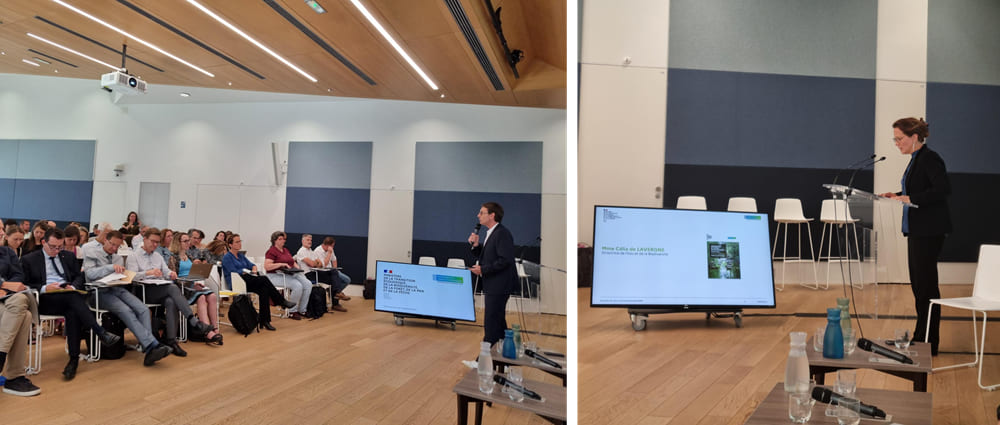
- June 24, 2025: Official launch at La Défense in Paris