
A-IGEco and its member networks are leading nine key actions to strengthen training and careers in biodiversity. These initiatives, supported by the Roadmap for Ecological Engineering and Engineering – Horizon 2030 (FdRIGE), the LIFE BIODIV’France project, and A-IGEco’s internal strategy, aim to structure, promote, and develop the skills needed for the ecological transition.
Discover how these concrete actions can support professionals and future talents in the industry.
🌱 Nine actions to strengthen training and careers in biodiversity
1. Promote the recognition and clarity of professions and training programs
Objective :
- An ambitious communication campaign to promote biodiversity careers to the general public and industry stakeholders.
- Creation of a national portal for professions and training, covering all initial and continuing training.
Pilots : OFB, A-IGÉCO
Framework: FdRIGE (Axis 3), LIFE BIODIV’France and A-IGEco Internal Strategy
→ Why is this important?
This action aims to make biodiversity careers more visible and attractive, by facilitating access to information for students, professionals and employers.
(Action in progress)
2. Structure and manage a national pool of trainers and experts
Objective :
- Create a network of expert trainers, organized by themes and territories.
- To animate and develop the skills of this network, by promoting the training of trainers and collaboration between stakeholders.
Pilots : OFB, RNF, AFIE
Cadre : FdRIGE et LIFE BIODIV’France
→ What does it consist of?
Un réseau structuré pour garantir une répartition équilibrée des compétences et une offre de formation de qualité sur tout le territoire.
(Action to be initiated)
3. Provisional catalogue of initial training courses in biodiversity
Objective: To write and put online a provisional catalogue of initial training courses in biodiversity.
Pilot : A-IGÉCO
Framework: LIFE BIODIV’France and A-IGEco Internal Strategy
→ The impact?
A practical tool for students and professionals to identify training programs suited to their needs.
(Action completed)
4. Label initial and continuing training programs
Objective: To label training programs to guarantee their quality and their suitability to the needs of the sector.
Pilots : A-IGÉCO, KALISTERRE, REVER
Framework: FdRIGE, LIFE BIODIV’France and A-IGEco Internal Strategy
→ Why is this crucial?
The certification process helps to promote the most relevant training programs and to secure career paths.
(Action in progress)
5. Identify and certify the skills blocks
Objective: To identify and certify the skill blocks for biodiversity professions, and to create a profession observatory.
Pilots : OFB, A-IGEco, RNF
Framework: FdRIGE, LIFE BIODIV’France and A-IGEco Internal Strategy
→ How does it work?
This action aims to officially recognize the skills acquired and integrate them into the national directories (RNCP or RS).
(Action in progress)
6. Create specialized schools dedicated to ecological engineering
Objective: To develop new training pathways with the creation of specialized application schools.
Pilots : OFB, UPGE
Cadre : FdRIGE et LIFE BIODIV’France
→ The impact?
Targeted training programs to meet the specific needs of ecological engineering professions.
(Action to be initiated)
7. Launch a Campus of Trades and Qualifications (CMQ) in Occitanie
Objective: To create a Campus of Trades and Qualifications in the Occitanie region, dedicated to biodiversity professions.
Pilots : A-IGÉCO, CGDD
Framework: FdRIGE and A-IGEco Internal Strategy
→ Why is this important?
A place of excellence to train future professionals and promote innovation in the sector.
(Action in progress)
8. Develop a continuing education program for professionals
Objective: To broaden the continuing education offer for biodiversity professionals.
Pilots : UPGE, AFIE
Framework: FdRIGE
→ What does it consist of?
Tailored training paths to allow professionals to learn throughout their careers.
(Action to be initiated)
9. Facilitate the Validation of Acquired Experience (VAE)
Objective: To develop VAE pathways to recognize skills acquired on the job.
Pilots : Kalisterre, REVER
Framework: FdRIGE
→ The impact?
Enabling professionals to enhance their experience and obtain recognized certifications.
(Action to be initiated)
8. Develop a continuing education program for professionals
Objective: To broaden the continuing education offer for biodiversity professionals.
Pilots : UPGE, AFIE
Framework: FdRIGE
→ What does it consist of?
Tailored training paths to allow professionals to learn throughout their careers.
(Action to be initiated)
🔍 Why are these actions essential?
These nine levers aim to:
- Making careers in biodiversity and ecological engineering more attractive.
- Structuring the training offer to meet market needs.
- To value skills and career paths.
- Innovating in training and support methods.
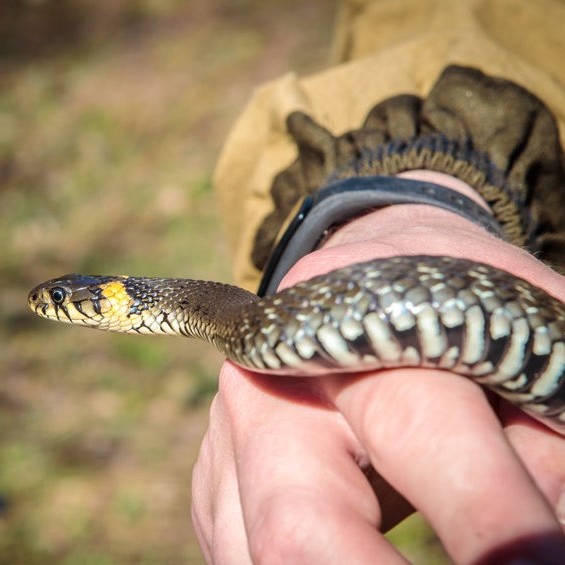
training in herpetology